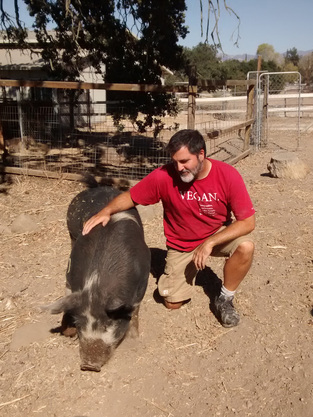
We are connecters, consumer educators, reminders that we are all interconnected.
The purpose of this website is to start a world revolution based on compassion and personal responsibility.
Our vision is a world driven by the innate goodness of people and their values of justice, kindness, and compassion for other people, for the planet, and for animals.
March 31 marks the birthday of Cesar Chavez, one of the all-time heroes of Nonviolence. Cesar understood the interconnection between human rights, environmental stewardship, and animal protection. He taught us how our consumer choices affect the world around us. And he truly “walked the talk” — making consumer choices connected to his values of kindness, justice, and compassion for other people, for the planet, and for all animals. Ahead of his time? Or, maybe, just in time.
We thought it might be helpful for those of you interested in practicing and advancing Active Nonviolence to offer a synopsis of what, strangely and sadly, is a rare find — a book looking deeply into Cesar Chavez’ genius in understanding and using Nonviolence.
This is not a book “review” but rather a short synopsis for those who can’t find time to read further. For those who can make the time, we highly recommend it.
Cesar Chavez and the Common Sense of Nonviolence Orosco, Jose-Antonio. 2008.
Albuquerque, NM: University of New Mexico Press.
Orosco points out that the contributions of Cesar Chavez to Nonviolence theory have been largely ignored or overlooked (as in Ira Chernus’ American Nonviolence) or have been kept in the shadow of the contributions of Martin Luther King, Jr.’s adaptations of the Nonviolent strategies of Mohandas Gandhi. With Cesar Chavez and the Common Sense of Nonviolence, Orosco places the spotlight on the unique aspects of Chavez’ contributions and the important differences between his ideas and the ideas of other Nonviolence theorists.
Orosco reminds us that Cesar Chavez (who only attended school through the eighth grade) tends not to be recognized in academic circles as an “intellectual” as are Gandhi, King, Richard Gregg, and Gene Sharp, but that this is an unfortunate oversight. He calls Chavez a “community intellectual” – someone who may not come from the world of academia, but nonetheless contributes to an important body of knowledge. Chavez’ knowledge instead comes from real-world experience and on-the-ground testing of his theories. But Chavez was also an accomplished speaker and speech writer. Most of Orosco’s claims of Chavez’ beliefs and strategies come from recorded and written speeches of Chavez during his activism spanning across four decades.
Orosco breaks the primary points of Chavez’ theory of Nonviolence into five distinct chapters:
Chapter one explains Chavez’ strategies for recruiting and activism. He drew from his experiences in the Latino/a culture to create a three-fold strategy that included pilgrimage (as in marching and suffering together to create a community of activists), penitence (evoking Christian beliefs of penitence and his own stress on the importance of reflection on motivations to make them unselfish), and revolution (while Orosco admits Chavez was a reformist working through political channels, he shows that Chavez’ long-term goal was nothing short of transforming the U.S. culture to one of compassion and cooperation).
Chapter two includes a strong and effective rebuttal to claims by some academics (specifically Ward Churchill) and activist theorists (specifically Che Guevara and Frantz Fanon) that Nonviolence bows to the state and remains impotent by ignoring violent means as potentially effective in creating social change. Orosco shows how Chavez claims that that type of thinking is limited in its creativity, ignores the true nature of power (as proposed by Gene Sharp and by Hannah Arendt), and is ultimately reverted to because of an inability to lead people (34). Regarding the nature of power, Chavez makes an interesting point about government in this chapter saying that the type of government really doesn’t matter – the will of the people is where power lies.
Chapter three included Chavez’ reasoning behind the fruitlessness (and dangers) of property destruction, mostly because it contradicts the end goal of Chavez – a just society.
Chapter four speaks to the claims that machismo equals violence. Chavez says that just the opposite is true – that giving one’s life to others is more powerful than taking lives. He supports feminist theory and the idea that power and the means for maintaining power should be available to all not just those with physical or political might. Orosco reminds us of the important roles of influential women in the lives of not only Chavez, but of Tolstoy, Gandhi, and King.
Finally, chapter five contrasts the use of time by King and Chavez. King used “crisis time” to evoke change and to motivate activists, the public, and politicians. Chavez resisted this tactic and instead set his strategy on moving toward a new social paradigm of collaboration. This required everyday citizens to maintain a “daily commitment” to Nonviolence and to the strategies that would lead toward a more just society – not simply a crisis-motivated piece of legislation. Orosco reminds us that King moved toward this strategic use of time and moral commitment after 1966 when he began to focus on the Vietnam War and the Poor People’s Campaign.
The presidential election is being held today in the U.S. Every 4 years voters pour their hearts and souls into one politician. They spend countless hours telling the world why their candidate is the best. Sometimes it’s a vote just to make sure the other candidate doesn’t get into office. Still it’s a vote. We wave our signs, tweet, and post to “get out and vote” because “every vote matters.”
So, which is it? Does your vote matter or doesn’t it. Are you hoping your vote today will somehow relieve you of your civic responsibility to vote every day?
Many people who are convinced that their vote every 4 years matters then go on to vote against their own values every day. They stand for environmental protection, kindness to animals, and human rights then go on to purchase chemical-laden foods, animal products, and items made using slave labor. They demand a stop to oil exploration, nuclear power, and “mountain top removal” for coal, yet they flip a switch at home or hop into their gas-powered cars or jet around the world as if their vote doesn’t doesn’t really matter.
Every Dollar Is A Vote!
Each of our choices in the past built the world we live in today. And each of our choices from this moment forward will build the world of tomorrow.
Our individual choices are VOTES! You are voting for and actively building the future… with each and every choice, and especially with each and every purchase. In the U.S. where the government and politicians are owned by corporations, your vote was cast long ago. There’s a reason why a corporate-owned warmonger will win the election — we put the candidates in place. We are then purposefully distracted by the idea that we now have a “choice” between candidates. Your choice was made long ago.
Your consumer choices act as the conscience of business. Businesses have grown so disconnected that they often only respond to money, not to moral principles. They no longer hear our pleas for kindness and ethics. If profits increase even though a company is spewing toxic fumes, enslaving people, or hurting animals, the company “believes” it is doing something right.
It’s not that these businesses are bad; they don’t know right from wrong — they are simply growing in the direction of YOUR votes. If your values and words which plead for humanity are drowned out by the clamor of your coins, you‘re saying to unthinking businesses, “Yes, keep doing what you’re doing… and do it in my name!”
In a corporatocracy (an economic and political system controlled by corporations or corporate interests), we must realize that government “representatives” represent the interests of their puppeteers *not* of the people. BUT, the people (each of us!) are the ones putting the puppeteers into place. We have control over our individual choices; our choices determine how the world runs, what forests get cut down, who lives and who dies. You have that kind of power. It’s an enormous responsibility, we know. But you’re already making those choices, you just might not be thinking that your vote matters.
Every dollar you spend or choose not to spend is a vote. You voted yesterday. You’ll vote today — maybe hundreds of times. Will you vote for a world that respects human rights, protects the environment, and has compassion for animals? Or will you make choices that build a world you really don’t believe in?
You help build a world reflective of our shared values of justice, kindness, and compassion only when your everyday choices are aligned with those values.
This question come from a friend. We thought we’d post the question and our answer here in case it’s of interest and of help to others:
Q: Someone just threw this quote at me about Gandhi and wondering if you had any thoughts on it? I was sure that Gandhi spoke of principled nonviolence until his death so I’m confused. Is Gandhi saying we should arm ourselves? Here’s the quote: ”Of this criticism, Gandhi stated, “There was a time when people listened to me because I showed them how to give fight to the British without arms when they had no arms [...] but today I am told that my non-violence can be of no avail against the [Hindu–Moslem riots] and, therefore, people should arm themselves for self-defense.”
A: This quote looks like it was pulled from Wikipedia (seeing it there in that abbreviated form on 08/08/2012). The quote you sent ends abruptly (is not the complete quote) and doesn’t relay the context. If you read more of the passage from which that excerpt was pulled, Gandhi’s next sentence is “If this is true, then it has to be admitted that our thirty years of non-violent practice was an utter waste of time.”
Gandhi was in no way advocating that people take up arms. Even that short misplaced quote doesn’t read that way if you pay attention to the construction of the sentence. In context it becomes even more clear that this is not a call for violence or armament, but rather a deep sorrow that for all of his efforts, the people of India did not take Nonviolence to heart. They didn’t live Nonviolence as a way of life – they simply used it as a tactic. And, accordingly, when they gained the upper hand they resorted to the weapon of those in illegitimate places of power – violence. Gandhi was despondent over this and wished people would see the error of their ways. He also lamented that he hadn’t the years or energy left to correct the error of his ways – in that he didn’t insist on Nonviolence as a way of life.
This is the message of Nonviolence United – trying, in a way, to salvage Gandhi’s legacy and to invite people to build a better world by building better selves – not by using Nonviolence as a tactic against anyone, but as a tool for togetherness.
It’s the political season. And those happily fooled and comfortably led are routing for their team — are they for the left or the right? Left? Right? Left, right, left, right, left, right. Sounds to me like they’re staying in line and marching in step.
Cheers to the free-thinkers occupying their lives, not distracted by the slight of hand and pretense that all we need are new leaders in Washington. You are the leaders and your everyday choices are your votes. Every choice you made in the past helped create the world we live in today. And every choice from this moment forward will help build the world of tomorrow.
Take personal responsibility — and cast your consumer votes daily as if lives depended on you; because they do. Live your values, change the world.
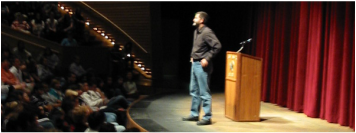
A powerful speech by Philip Wollen, Australian philanthropist and former VP of Citibank about the power of living with compassion for those with whom we share this fragile planet. It’s wonderful to see someone so ingrained in the culture of opulence connect with their truest sense of justice and make the personal commitment to do better. Thank you, Mr. Wollen.
Most of us have felt the unconditional love of an animal… that deep bond that seems to go beyond our human connections. We talk to our dogs and to our cats and sometimes we connect with them more deeply than with anyone else. They love us… and we love them.
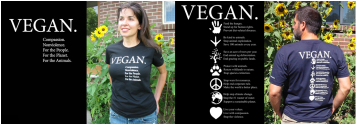
You can feel that connection again and again by giving your love to every animal — those we call our pets, wild animals, and those who suffer on farms and in factory farms. Make Vegan and cruelty-free choices to align with your true love for animals.
Expand your circle of compassion and the love will come back to you a thousand times.
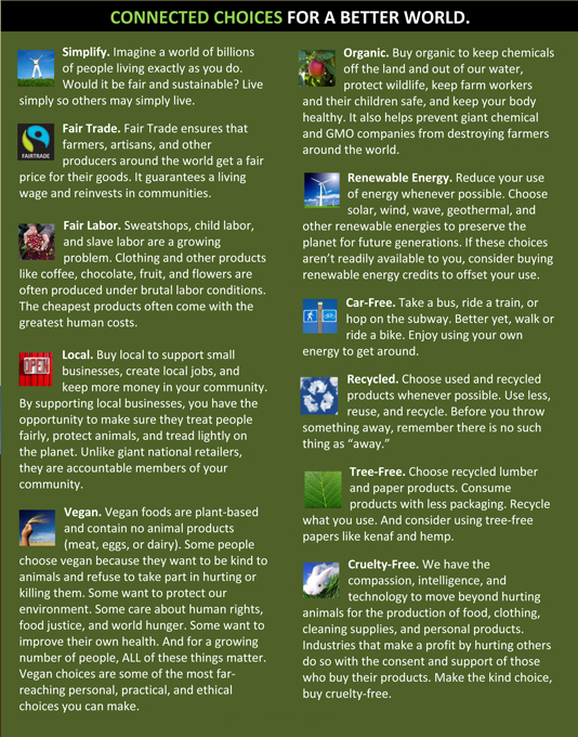
Visit ALifeConnected.org for ideas on everyday choices that can help build a better world.
We posted this earlier in a longer article. But, the article was so long many people didn’t read far enough to find it. So we offer this again in the spirit of helping you, the world, and the emerging Occupy Movement.
THIS IS A CONSUMER REVOLUTION. The state of the world is not being done TO us; it is being done BY us. The solution isn’t outside us, it isn’t in the next political savior, it isn’t on Wall Street. Every consumer choice EACH of us made in the past helped build the world we live in today. WE put those in power who are in power today. WE polluted, we enslaved, we killed, WE paid for it all. This isn’t about evil corporations, it’s about UNTHINKING CONSUMERISM.
NOW, every single choice from this moment forward will build the world of tomorrow. SHIFT THAT POWER! If you consume consciously only things that are aligned with your values of KINDNESS, JUSTICE, and COMPASSION… THAT is the world you will build. If not, expect more of the same — a world out of control, twisted against everything we stand for. This is our great power; this is our great responsibility.
Recognize that YOU already have the power. YOU always have. Politicians aren’t going to change that. Corporations aren’t going to change that. YOU matter and YOU make a difference.
THIS IS SO IMPORTANT TO GRASP because THIS is the Movement. Everyone, every single human being is a consumer. I don’t mean “shop till you drop” consumption (although many are dropping because of our consumption). I mean we must consume (eat, drink, dress ourselves, find shelter, etc.) to survive. Those simple consumer choices are not so simple and they are not personal choices — every choice you make has an impact on the world around you, on everyone, on everything. We’ve been making unthinking consumer choice through:
clothing (supporting slavery and prison labor, polluting, often killing animals)
shelter (destroying the planet, using non-renewable resources, stealing from future generations)
And the rest is just stuff we don’t even NEED! What were we thinking? Answer: we weren’t. Well, now we are! Now we must!
If you’re not in the streets protesting (and even if you are), you’re still a part of this movement. Every human being is part of this Movement. Every single consumer/human is building toward a new system of justice or perpetuating the system of exploitation. It really is that simple.
EVERY consumer choice you make, EVERYTHING you buy or decide NOT to buy is either part of the solution or part of the problem. It’s part of the collaborative NEW PARADIGM or it is in direct support of the violent exploitative paradigm you are actively fighting against.
“Talk is cheap; it’s how we organize and live our lives that says what we stand for.” - Cesar Chavez
Even if you’re in the streets “fighting for what’s right” — if you’re buying/wearing your Nike slave labor chemical soaked animal skin shoes, eating a McDonald’s burger (or any animal product), snacking on Hershey’s slave-labor cow’s-milk chocolate, driving your new gas-powered car, and wondering how your 401k might be doing rather than WHAT it is doing (not even knowing in what you’re invested)… are you really part of the solution? Are you really part of the new paradigm? Or are you just wasting your time — nailing one foot to the floor before running the marathon.
THIS is the Movement. It’s a conscious CONSUMER REVOLUTION. It is a movement of personal responsibility, of personal conscience, of BRAVERY to step out of the confines and comfort of the way it has been into the light of how it could be.
It’s time for a revolution. The weapon is in your heart. The weapon is love. It can not run out of ammunition; it cannot be disarmed; and when the war is won, we all win.
Years ago I’d ask audiences, “Who thinks corporations have too much control over our governments, over our lives?” Maybe 1/2 would slowly raise their hands and I’d have to explain what I meant.
Today every hand in the room shoots up… and some people stand up and cheer!
“Why do these giant corporations have so much power?” I’d ask.
“They have all the money!” someone yells.
“And where do they get the money?”…
Silence.
“Oh… us.”
The state of the world isn’t being done TO us; it’s being done BY us. We have the power to turn it around. Consume consciously. In every part of your life. What you eat, buy, consume, read, watch…
The question is not, “Can ONE person really make a difference?” You already ARE making a difference. The question is, “What kind of difference do you want to make?” Will you be part of the ongoing problem; or will you be part of the solution. Yes, you matter. The power is in your hands.
This is a short answer to a question sent to NonviolenceUnited.org (thank you for the question!)
Q: What is violence and what are some examples of “violence against Society?”
A: We are all connected. More and more people are beginning to re-understand this interconnectedness – that our choices and actions affect not only our lives but the lives of others – even on the other side of the planet, even those we’ll never meet. We are all connected. violence, in a nutshell…is anything that works against that natural interconnectedness – it’s an expression of disconnection.
Martin Luther King, Jr. explained that “We are tied together in the single garment of destiny… and for some strange reason I can never be what I ought to be until you are what you ought to be. And you can never be what you ought to be until I am what I ought to be.” To reach our potential, we must be mutually supportive of one another.
And violence against society? Ultimately, any form of violence works against society because it works to unravel that fabric of an interdependent community. But, violence takes many forms. We’re so immersed in outright physical violence (war, terrorism by the state and by individuals, domestic violence, child abuse, robbery, rape, murder, drug wars, and so much more) that sometimes we may not recognize the other rampant violence of racism, militarism, speciesism, poverty and materialism (and by this, I mean individual over-consumption as well as the corporatized propaganda and policy that drive it). Paraphrasing Gandhi, when we use more than we need, we are stealing from someone else.
So, violence against society is basically “othering” within the community (world community or other smaller community). It is the creating an “other” out of someone who is actuality a part of US, who we’re in reality connected to. Othering is an irrational, unnecessary, and certainly hurtful belief that anyone in our world community (all humans and all non-human animals… and even nature itself) are somehow separate from ourselves.
The essence of nonviolence is love. Out of love and the willingness to act selflessly, strategies, tactics, and techniques for a nonviolent struggle arise naturally. Nonviolence is not a dogma; it is a process. — Thich Nhat Hanh